Toki: Logic-driven puzzle-platformer with precise tool puzzles
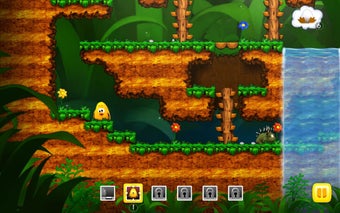
Toki Tori, developed by Two Tribes, is a puzzle-platformer that puts the player in control of a young chick tasked with collecting eggs across handcrafted stages. The game emphasizes strategic problem solving through a limited toolkit and level-based puzzles rather than reflex tests. It ships with dozens of levels, themed worlds, and accessibility features aimed at puzzle fans and players who favor planning over fast platforming action.
What kind of game is Toki Tori?
In this game, movement becomes a design constraint because the protagonist cannot jump, so traversal itself forms part of each puzzle. Players map routes, trigger environmental reactions, and combine a handful of specialized tools to manipulate the stage. The core loop asks you to observe, experiment, and deduce a multi-step solution, rewarding pattern recognition and sequence planning rather than speed or precise platforming reflexes.
How does progression and the Wildcard system affect play?
Inside each world, progression is non-linear thanks to a Wildcard system that permits skipping problematic stages, which cuts down on blocked progress and encourages returning later with new approaches. The structure pairs open routing with achievement tracking and cloud save support for cross-platform progress. Later stages increase puzzle density, pushing players toward longer, interconnected solutions that suit thoughtful pacing over short bursts of action.
What does the game look and sound like?
On Mac the edition upgrades hand-drawn visuals into an enhanced HD presentation and includes a 5.1 surround soundtrack that underscores puzzle cues. The interface keeps on-screen elements minimal to keep puzzle state clear. Controls are adapted for mouse, keyboard, and gamepads, and the Mac build includes multi-touch trackpad support. Technical needs remain modest, near 200 MB of disk space and roughly 1 GB of RAM.
Is it hard to get started?
Beginning sessions are approachable because objectives and actions are simple, so younger players and newcomers get into the loop quickly. Challenge ramps as stages require chaining tools across several steps and timing interactions precisely, which produces a steeper test for veteran puzzlers. The design rewards observation and iteration: many solutions become visible only after experimenting with cause-and-effect across multiple moves.
Recommendation
Toki is a steady choice for puzzle players who enjoy deliberate, multi-step problem solving, because stages emphasize planning and environmental interaction over reflexes. However, the enforced no-jump movement can alienate players seeking traditional, reflex-driven platforming. For those who prefer methodical challenges and thoughtful sequences, the game rewards persistence and observation, offering extended play driven by puzzle discovery rather than speed.